|
Sitemap (Site Index)
|
Footwork and Stances
|
|
Sitemap (Site Index)
|
Footwork and Stances
|
|
Chapters dealing with the proper use of windmills...
The Basic 8 Exercise |
|||||||||||||||||||||
|
Click here to watch Jimmy H. Woo demonstrate "The Basic 8 Stances"
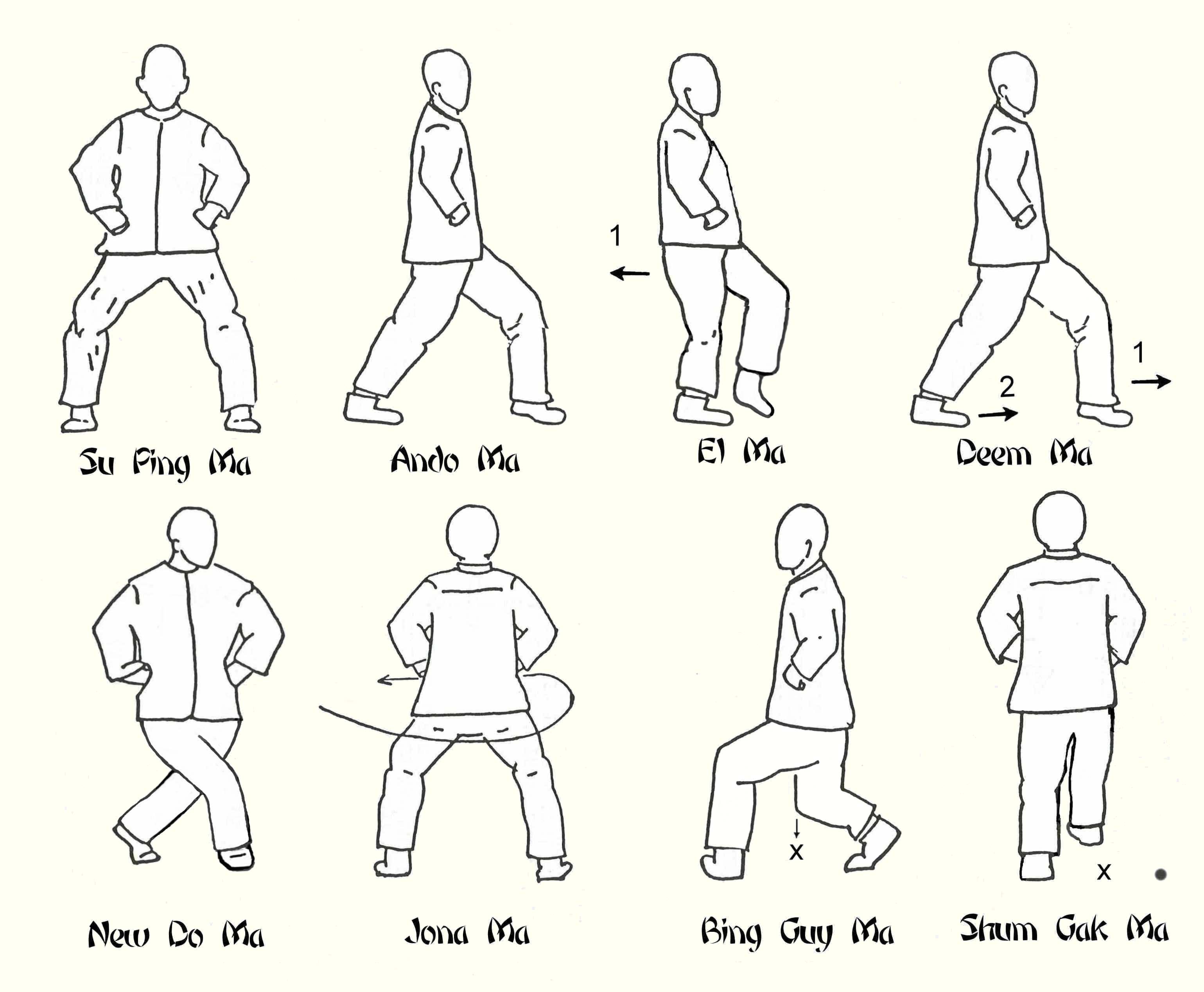
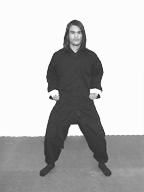
Note: All rotating is done on the balls of the feet. Feet do not move at the same time. When one foot moves, the other is at rest. During the exercise, the hip remains level and does not bob up and down. The exercise begins from set position, hands on hips. The heels of the feet are touching and the feet form a "V". 1. Su Ping Ma (Full or Center Horse Stance) From set position, pick up the right foot and move it in a clockwise arc, putting it down, to your right, at a point, just past your right shoulder. Next, move the left foot in a counter clockwise arc, placing it at a point just past your left shoulder. The toes of the feet remain pointed at a 30 degree angle to each side. Proper horse distance is 28 - 30 inches. 2. Ando Ma (Half Horse Stance) Turn the hips and right foot counter clockwise, to your left, until the right foot points about 35 degrees right of the line of your heels. During the execution of this movement, the left foot for the most part, remains stationary but is allowed to adjust slightly in a counter -clockwise direction. The left foot’s final position is also about 35 degrees with respect to the line of the heels, or parallel to the right foot. 3. El Ma (Kick Stance) Move the hips, back, over the right foot, allowing the right leg to bend at the knee. Draw your left foot back, putting the left toes down very slightly ahead of the right toes. All weight is on the rear leg. 4. Deem Ma (Slide Stance) From the kick stance, move the left foot to a point about a horse and one-half ahead of the right foot. The left foot travels in a slight clockwise arc, and the left toes will be pointing about 35 degrees to the right. Now, pull the back leg up till the legs are, again, one horse distance apart. Be sure that the right foot points about 20 degrees right of the line of your heels. 5. New Do Ma (Cross Stance) Swing the right foot in a counter clockwise arc placing the right foot, on line, ahead of the left foot. The right toes point about 60 degree to the right. As the right foot makes contact, the left knee bends, moves forward and comes to rest, touching the top of the right calf. The left big toe points slightly right of the right big toe. 6. Jona Ma (Turning Horse) Rotate the upper body 90 degrees, counter clockwise, and allow the left foot to rotate on its ball, at the same time. The hips and foot turn until the left foot is nearly parallel to the right foot. Like the plie (plee-ay) position in ballet. As you are doing this, do not allow the right foot to move. As you set the weight on the left foot, now, begin to rotate the right foot, counter clockwise on the ball, about 105 degrees, until a Su Ping Ma is formed. Note the point that your bent knee is now hovering over. 7. Bing Guy Ma (Kneeling Stance) Continue twisting counter clockwise turning the right knee down down. The left foot does not move! The right foot rotates until the right foot points about 20 degrees right of the line of your heels. At the same time bend and drop the knee half way down toward a point between the legs. 8. Shum Gak Ma (Triangle Stance) Draw the right foot towards your left foot and circle it clockwise, stepping 45 degrees out to a location directly above the previously noted point. |
|||||||||||||||||||||
|
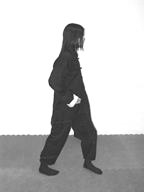
The axial shift is the most often used shifting pattern in Kung-Fu San Soo. It is executed in a fluid manner. So we start with a right half horse. For a student of average height, the horse's gait should not exceed 28 inches. Please note that deep, long horses are a tactical liability and make the following procedure difficult to execute. In a proper right half horse, the right foot is pointing about 35 degrees to the left and the left foot parallels the front foot. The left leg should be straight and locked. What is important, here, is that the rear knee is pointing downward, and not to the left, and that the rear leg is straight. To begin shifting, we pull our left heel inward, counter-clockwise to the right, pivoting on the ball of that foot. One's hips move left and center between the two legs. At this point, we are in a full horse with the weight of our body evenly placed between our feet. We then rock our weight onto our left foot and roll our entire hip, right leg, and right foot, as one unit, to the left, until the right big toe is pointing slightly to the right of our left big toe. The right leg is then straightened, as the heel is placed on the floor. The leg locks at the knee; the knee is pointing downward. Note that during these movements, the left knee will flex to a point above the left toes. It is critical that the forward swing of the lower leg be on the same line as its foot; the ankle then works in a natural fashion. One must not place a bias against the joint. During the execution of a straight punch, the two legs rotate in close synchronization, appearing to move almost simultaneously. A roundhouse punch, however produces a greater lag time between the two foot movements, making them appear as two separate movements. During the execution of the Axial Shift, it is important to insure that one foot maintains contact with the ground at all times, albeit momentary. When both feet twist simultaneously contact with the ground is at a minimum. In general our feet appear parallel to each other throughout the shift. Good footing and good balance go hand-in-hand.
The Axial Shift
The shifting method used by the San Soo practitioner is in many ways similar to the one used by a batter, in baseball. And, to be sure, the mustering of a sword and a bat share many common attributes. However, unlike this batting procedure, the rear foot must remain on the ground, straight and locked at the knee. When we hit a baseball, which is relatively small and light, the contact usually does not have a harmful effect on our balance. However, when we contact our opponent, his mass is far larger and so his inertial forces are of a far more serious nature and affect us all the more. Support from the rear leg "strut" is essential. It is important to note that, as we shift, the use of the arms and their windmills is fundamentally important to the initiation of the shift and the stability of the entire movement. In general, the arms are used in tandem with their respective hip and leg. The Form is an excellent activity for the practice of the arm movements (windmills) and leg movements so necessary in the development of proper shifting. It is vitally important that a practitioner learn to shift properly and completely. Incomplete shifting destroys the natural flow of Kung-Fu. Good shifting is a prerequisite for the mastering of advanced technique and movement in the art of San Soo.
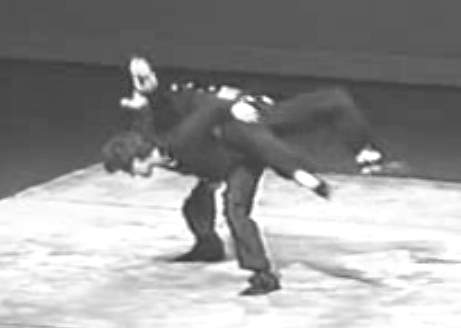
The smooth shift, shown above, requires the forward leg to bear about 60 percent of the body weight. This allows for proper heel to toe transfer of the weight on the forward leg. This depiction allows the fighter to keep his foundation steady and under control throughout the movement. Now, if one intentionally moves his weight fully onto the forward leg, this motion can be spun into a progressive pivot. This movement has been likened to “tornado motion”. It is really very spectacular. Finally, one can shift keeping his weight over the rear foot for a more prolonged period. This creates a back stance where the head and upper body actually move away from the opponent. This type of shift is very helpful in sword work.
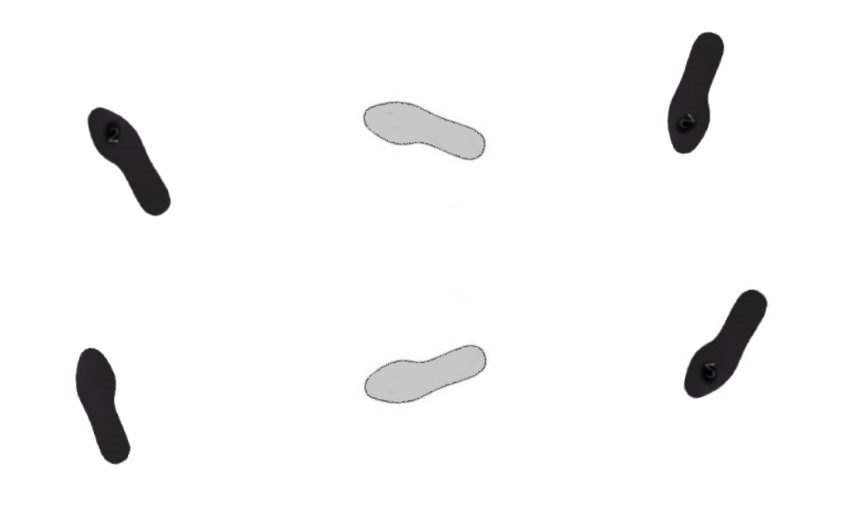
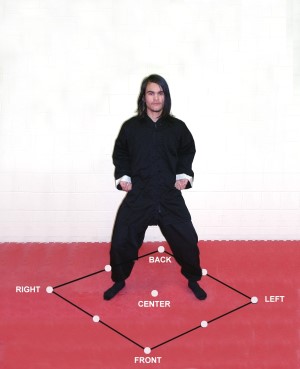
By definition, a line is created when two points are connected. When the practitioner is standing in a horse stance, he occupies two points - each foot residing on a point of its own. The connection of these points creates what is called the BASELINE. Picking up a foot and stepping to a third point creates a TRIANGLE, which can be visualized by connecting the two original points of occupation and the newly created point to which the stepping foot was moved. When approaching an opponent, placing one’s feet in a precise manner is crucial to the effectiveness of the upcoming technique. Clearly, a powerful technique requires the stability and leverage produced by the proper positioning of the body. Footwork is of the highest importance. As forces are applied, poor placement will ultimately lead to a loss of balance. Lacking balance, the fighter’s technique will surely be compromised.
The
line of the opponent’s heels is called the BASELINE. When the fighter occupies two adjacent points on the diamond, it can be said that he has “SETUP” the opponent. When the punch is landed, its contact point and the two points occupied by his feet share a triangle relationship which effectively supports the blow. In moving from point to point, if the fighter’s limb should pass through the opponent’s body or leg, all the better. The leg passing through the opponent’s body, on its way to another point, is called a KICK. Similarly, the leg moving through the opponent’s leg is a SWEEP. As shown above, the fighting diamond is visualized with respect to the opponent’s BASELINE. As an opponent is struck, and forced to move, the baseline swings with him, and so too, the fighting diamond. As a result, the fighter will lose his placement. The exponent will now be required to take another step or steps to regain his position on the diamond and in so doing, maintain the SETUP.
kfss@sansoostudio.com · (818) 996-7832 |
|||||||||||||||||||||